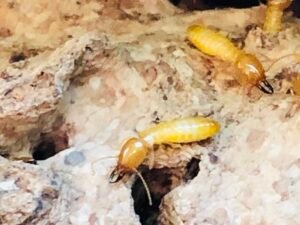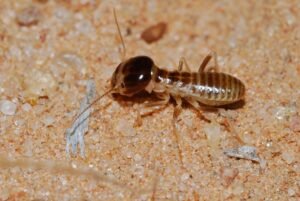
There is a nest of bugs
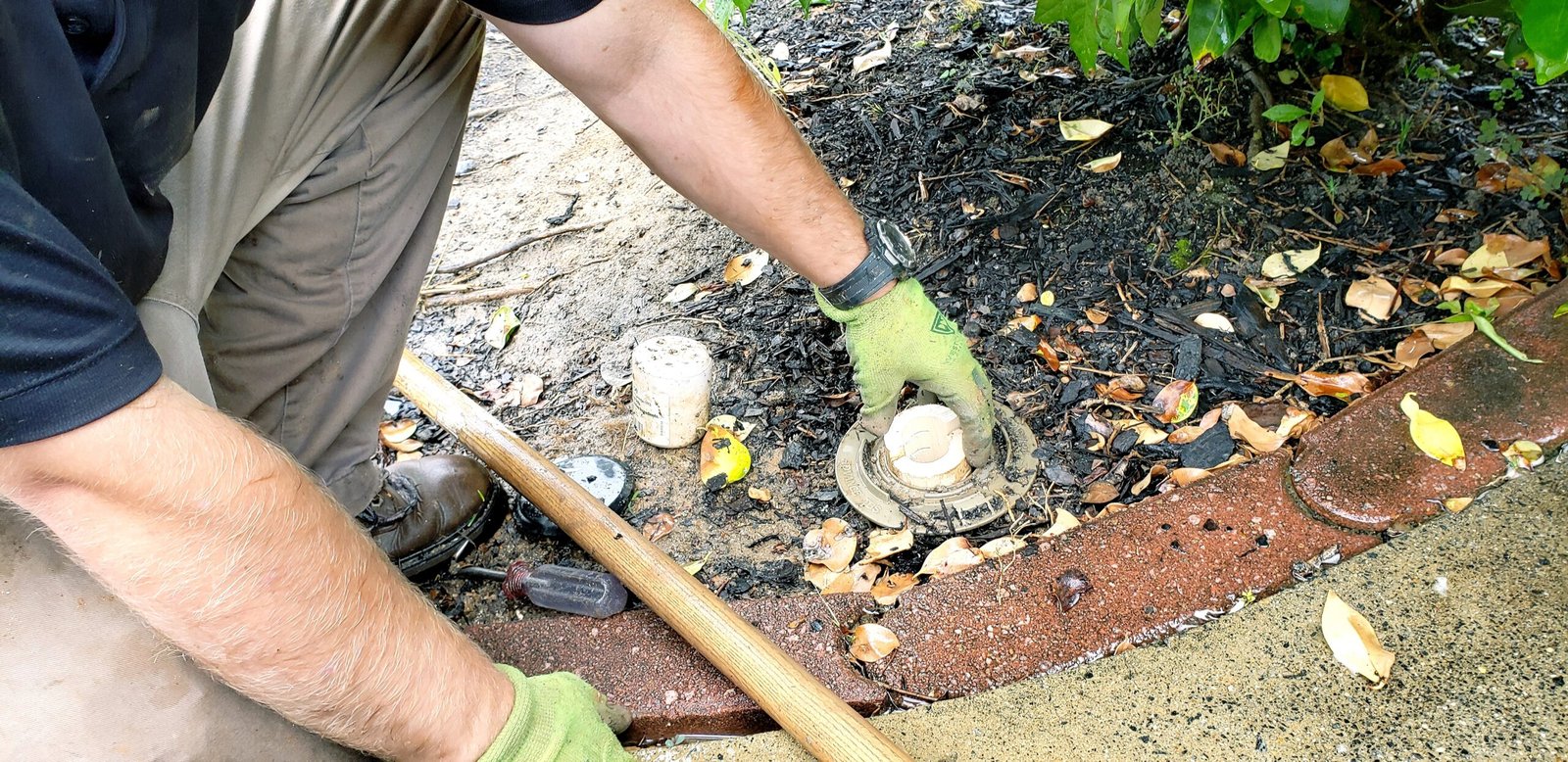
Subterranean termite nest.
Drywood termites are pale yellowish-white to cream coloured and about 1/8 inch (3mm) long. They live inside dry wood with round holes as the only evidence of their presence except for what looks like sawdust around these holes; this is actually dried-up body contents(frass). Drywood termites form many nests within one colony unlike subter termites which make one main nest.>Dampwood termites are brick red to dark brown in colour and about 1/2 inch (12mm) in length. The largest of the southern species, they also have visible golden-yellow wing veins. Their nests are typically in wood which is always damp or even submerged under water, hence their name. They leave thick black mud tubes on structures above ground level similar to what subterranean termites do.
Subterranean termites are mahogany brown with cream coloured banding around the abdomen. Adults reach only about 1/4 inch (6mm) long but can live several years underground before reaching maturity, if conditions are right for them. Like other kinds of termite, they live hidden within soil or wood, eating what they find. Subterranean termites form nests underground or within the wood they are eating.
Termites are known to be what do termites look like. Termites, what do dampwood termite castes look like can be easily confused for ants or cockroaches, but their long thin antennae and soft bodies reveal them as what is what a termite queen looks like at 0:22. They prefer to eat wood; the characteristic ‘hollowed-out’ look of infested timber, along with the droppings, can be an indicator .
Termites are pests that live in colonies, which grow to contain several thousand insects. Both nymphs and adults eat wood, their poo is known as frass (termite droppings) and piles of it could be a sign of termites. The characteristic ‘hollowed-out’ look of infested timber, along with the droppings, are good indicators. The termites themselves are dark-coloured (Dampwood termites can be slightly orange), small and thin, with soft bodies that only become visible when swarmed during mating periods; although sometimes they might be found in small groups or even alone.
The termites themselves are dark-coloured (Dampwood termites can be slightly orange), small and thin, with soft bodies that only become visible when swarmed during mating periods; although sometimes they might be found in small groups or even alone.
The life cycle begins when a winged male and female swarm together from what appears to be nowhere. At this point what you’ll find is tiny, dark-coloured insects.
This mating stage only lasts for about 3 to 5 minutes before the male dies and the female finds a place to start a new colony.
The eggs they lay lead to what’s known as an ‘eft’ or nymph in its early stages of life, which has no eyes or legs until it begins feeding on wood. Once their mouth parts are developed enough to eat wood, they develop into what looks like the adult form with six legs but still no eyes.
These ‘worker’ termites are what actually do all of the eating in the colony during their lifetime – estimated at around 10 years in most cases!
When worker termites are in the later stages of their life, they become what’s known as ‘soldiers’ which have large pincers to protect what’s left of the colony.
This is what termites look like when together – dark-coloured insects with little black eyes, long antennae and six legs. Without wings it would be impossible to identify what type of termite you’re looking at!
Know more here https://en.wikipedia.org/wiki/Termite